Tuesday, April 21, 2009

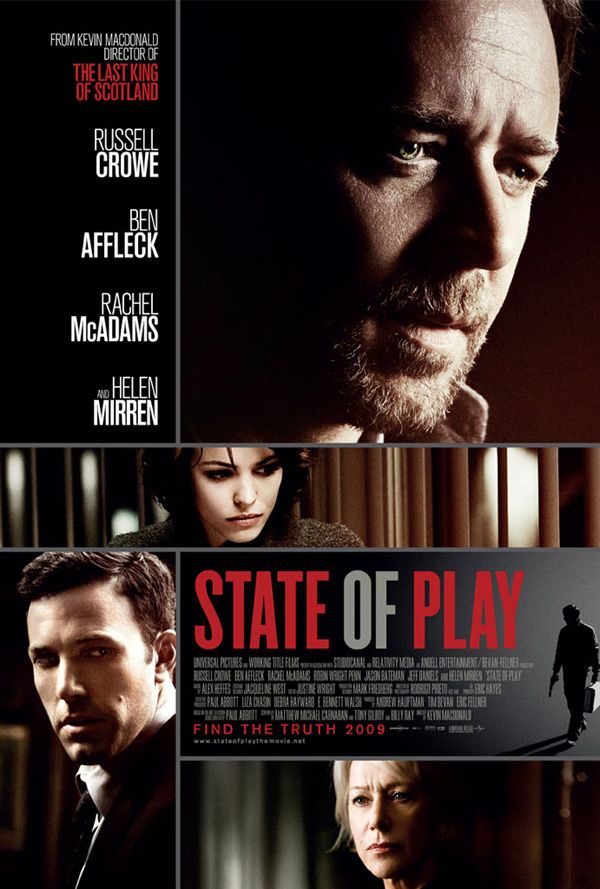
State Of Play


State of Play, a political conspiracy thriller, is Kevin MacDonald’s first film since the gritty critically acclaimed The Last King of Scotland (2006). With its numerous references to Watergate (and a Bob Woodward cameo), MacDonald is obviously paying homage to the most famous of political thrillers - All The Presidents Men (1976).

After two seemingly unrelated events, a double homicide and a tragic accident, congressmen Steven Collins (Affleck) is informed that the second of those incidents involved his research assistant Sonia Baker. Within hours, revelations that the married Collins was having an affair with Sonia and that it may have been suicide rather than accident is the headline on every news channel. With nowhere else to turn Collins asks his former college roommate and now reporter Cal McAffrey (Crowe) for help. As McAffrey starts to dig further he quickly realises he may have stumbled on a political conspiracy involving those at the highest levels of public office.

The cinematography in State of Play is impressive at times, as is the dialogue. MacDonald manages to keep the audience interested throughout and there are some excellent moments in the film, including one particularly tense scene in an underground car park. However MacDonald fails to get the performances here that made The Last King of Scotland such a good movie and won Forest Whitaker an Oscar. While Crowe’s McAffrey comes across dedicated and principled and Affleck’s Collins as ambitious and a little morally ambiguous, MacDonald never really manages to get to the core of what drives these characters. Furthermore the friendship between the two never seems credible. In the supporting roles McAdams turns in a solid if unexceptional performance as McAffrey‘s colleague , while Helen Mirrens editor and Jeff Daniels congressman never offer more than platitudes. Jason Bateman stands out from the crowd in another fine performance as the sleazy Dominic Foy.

While the plot in State of Play is not exactly original, it does hit on some interesting issues such as the influence of the military-industrial complex in the US. It’s a pity that MacDonald chooses not to focus more on that theme. Perhaps much of the criticism stems from the slight sense of a missed opportunity. All the ingredients were present here for a great film and while we don’t get that we do get an enjoyable one, worth a trip to the cinema!

Rating: 3.5/5

Friday, February 6, 2009

Waltz With Bashir - One Sentence Review


Waltz with Bashir is less about the massacre which occurred during the 1982 conflict between Israel and Lebanon and more about the elusive and ever changing nature of memory; Waltz with Bashir is subtly evocative and utterly compelling despite it's only flaw which is a sometimes rigid human animation, one of 2008's best films.

4.5/5

Wednesday, February 4, 2009

'Frost/Nixon' One Sentence Review


With excellent performances from it's leads, notably Frank Langella's Nixon which will forever be the watermark, this enjoyable film adaptation of the successful stage play stumbles by way of the insertion of a 'faux' documentary which unforgivably distracts from Ron Howard's best film since Apollo 13.

3.5/5

Wednesday, January 28, 2009

Rachel Getting Married - One Sentence Review

Though, admirably and stylishly realised with a genuine sense of atmosphere, whilst managing to point out that the cultural and familial identity of an American wedding is fluid and not fixed, this is a deeply unsatisfying film, featuring extremely unlikable characters with almost no redeeming features, who fail to even manage to be compelling in their unpleasantness and ultimately, this utterly charmless movie cops out and leads an interesting set-up into an unfulfilling dead end full of artificial and un-earned hints at redemption.

2.5/5 (The extra half is for style and atmosphere)

Wednesday, January 21, 2009

The Reader - One Sentence Review


Whilst this may look like the same old, sombre, Nazi drearathon, from oh-so-worthy director Steven Daldry, it's actually an affecting and better-than-expected tale of guilt, what if anything we can learn from it and how story telling can help, though some (not us) may view the deliberate withholding of catharsis as disappointing.
4/5

Monday, January 19, 2009

One Sentence Review: ‘Slumdog Millionaire’


Danny Boyle has fashioned a ripping escapist yarn out of the bleakest of settings, harnessing wonderful performances and using the camera like it’s a bullwhip yet, oddly, it’s the slickness and lightening pace of the opening ten minutes that may be one of ‘Millionaire’s fundamental flaws which left this viewer slightly apathetic to our central character’s quest.

3.5/5

Thursday, January 15, 2009

One Sentence Review: ‘Defiance’


This well produced true life story of three brothers who defy the Nazi’s, by not dying, gets off to an enjoyable start but quickly gets stuck in its own mud by, surprisingly, lacking enough tension within the compound scenes and whose bland characters feel like they were written by Edward Zwick to be in an Edward Zwick film, which they were.
2.5/5

Sunday, January 11, 2009

One Sentence Film Review: Role Models


With a funny-as-hell trailer, Rodel Models has little more to offer once you watch the movie; relying too heavily on comedic improvisation and the novelty of a swearing ten year old, this weak scripted film enters yawn territory thirty minutes in.
2/5

Thursday, November 6, 2008

Hunger Review


The 1981 IRA hunger strikes have been done on film before. We've had Terry George's Some Mother's Son a powerfully emotive piece featuring standout performances from Helen Mirren and Aiden Gillen. We've also had the lesser seen H3. So why do it again? As always, the answer to this question - whether it be asked about remakes or the rehashing of popular subjects - is simple. There is no reason to do it again unless you are trying something completely different.

And Hunger, directed by first time director and former visual artist Steve McQueen (no, not that one), is certainly something different and some will find that alienating. The standard operating procedure when dealing with a true-life historical story is to explore the world through a character's eyes. Tell their story and allow the audience to connect, empathise and have a cathartic experience as they partake in the character's transformation. This approach works, time and time again but it is by no means easy to achieve. But it's not the only way to tell a story. It is simply the most reliable.

Hunger flips the script and rips up the rule book. It eschews the traditional 3-act structure (though it is still resolutely in 3 acts). It deliberately switches point-of-view, preventing the audience from identifying with any one character and their world view or political point of view. While we feel empathy, we are not encouraged to position ourselves with any of the characters. Dialogue is used sparingly until suddenly we are cast into a 15-minute scene in which two people talk to each other in a simple 2-shot without any cuts. Narrative resolution is deemed unnecessary and character's arcs are dropped mid-stream, again discouraging identification.

Of course, many may find this frustrating because, it is unnatural and not commendable for its own sake. It is only laudable if these choices achieve something else. And they do. They allow a political hot potato of a story to be told relatively objectively, which prevents the movie from being dismissed by critics as an apology for terrorists. It forces the audience to feel the effect of the events for themselves. Rather than identifying with characters you identify with the pure pain, suffering, hardship and human strength, independent of too much context. Again, this would not work if the pain and suffering wasn't so brutally rendered and if it failed to shake the audience to its core.

None of this sounds like an entertaining night at the cinema but it is an expert peice of filmmaking that is engaging in its brutal honesty.
4/5

Friday, September 26, 2008

Man On Wire


In 1974 daredevil wirewalker, Philippe Petit, carried out the greatest ‘artistic crime’ of the twentieth century by fastening a cable between the roofs of the two towers of the World Trade Center and walking across it.

At a time when all films seem to have the sub text of the 9/11 disaster lurking in the background; it is a breath of fresh air to watch a documentary where the towers are portrayed as a symbol of hope, of human endeavour and of man’s unyielding urge to go where no man has gone before.

Our animated and tenacious hero, Philippe Petit, narrates the story along with the rest of his crew taking us through the years of preparation which was required to pull off this incredible act. From the first moment when Petit was inspired; by drawing a line between the towers in a dentist office, to the thrilling events of breaking into the World Trade Center and actually executing the heist.

Petit saw this mission not as a performance but as a bank job and that is how director, James Marsh, treats the subject. He has masterfully constructed this tale into what feels like a 70’s crime thriller; opening the story as the crew are infiltrating the World Trade Center and twisting the screw of tension almost to breaking point only to jump out for rest bite and fill in the back story which fleshes out the characters and efforts which they have taken to get to their point of no return.

Yet underneath the excitement of this compelling narrative lies the story of two men, Philippe and Jean-Louis, who are as if bounded by fate to be on this mission. Philppe’s blind determination is balanced by Jean-Louis’s pragmatism. As if Jean-Louis is destined to be carrying the weight of potential failure for Philippe so that he can blindly step into the abyss between those towers with child like glee and excitement.

Man On Wire is an uplifting and thrilling story which dares you to chase after your dreams no matter how peril filled they may be. A must see.

4.5/5

Monday, September 15, 2008

Pineapple Express


When people mention Pineapple Express, it is usually in the same breath as Superbad and occasionally Knocked Up. Granted, Evan Goldberg and Seth Rogen were behind all three movies (to varying degrees) and they all come from the Apatow stable - which is now enjoying the inevitable backlash from critics - but to call it a follow-up and imply a more-of-the-same attitude is to do it a disservice. Pineapple Express is not another teen comedy or another frat-boy-comes-of-age movie, where the characters find themselves in embarrassing, socially awkward situations and generally make fools of themselves, while having the breathing room to improv and riff off each other with hilarious results.

No, Pineapple Express is a very different beast. It's a 'genre' movie bringing with it all the associated challenges. It's an Action Comedy. It's a Stoner Action Comedy to be more specific. For a stoner action comedy you're gonna need a significant plot, you're gonna need lengthy elaborate action sequences, you're gonna need the obligatory smoking sequences and cheap stoner gags and on top of that you're gonna need to be funny, so funny in fact, that you don't suffer in comparison to Superbad. That's a tall order. How did they set about achieving it? Well, by doing almost everything differently, something to be roundly applauded.

They keep the plot fairly simple; Seth Rogen's pot-smoking loser, witnesses a murder and has to go on the run with his dealer, getting unwittingly caught up in a war between 2 rival drug gangs in the process. As far as the, action sequences go they stick rigidly to one rule. These guys are not action stars! They are stoners! So we have no athletic, quick-thinking bad-ass action moves, followed by comedic quips ala Lethal Weapon or Rush Hour. Instead the comedy comes from their complete inability to achieve anything remotely physical. There is one sequence in which the pugilists even seem incapable of hurting each other because they are completely lacking in any physical prowess, ingenuity, strength or athleticism. Apparently the idea for this movie came from asking, what if the bad guys had chased Brad Pitt in True Romance instead of Christian Slater. Just like Lebowski was thrown into a Film Noir plot for comedy gold, they throw two everyman stoners into a convoluted action movie set-up and have them react almost realistically to every situation i.e. with utter panic, inarticulacy and incompetence. These guys are not Mel Gibson.

As far as the stoner comedy goes, there almost is none. Don't get us wrong, they mine the fact that the characters are stoned in the most inappropriate situations for all it's worth. They just don't assume for one moment that smoking weed in itself is funny. It's all about the context. One example: Smoking weed = boring. Selling weed to 12-year-olds to get money to flee town, smoking it with them, thinking you're cool but ultimately getting so stoned that you get caught by the police = funny.

In all this perhaps accidental innovation, they don't quite achieve everything. They don't achieve the same comedy hit rate that Superbad managed as they just aren't allowed spend as much time mining for laughs. Also, the success of the their previous efforts has often been down to the audience getting to spend time with a group of friends who have a ready-made sense of humour complete with recognisable rivalries, resentments and raillery. This is more about the burgeoning of a friendship rather than the exploration of an existing one. And yet again Rogen and Goldberg have tooled their script as a love story between two males. Of course buddy comedies always have that undercurrent (witness the countless Brokeback Mountain trailer parodies) but Pineapple Express - and Superbad before it - dispense with the coyness and overtly set up the relationship of a weed smoker and his dealer as essentially a fuck-buddy relationship that turns into love. The attempt to invest this friendship with such metaphorical undertones (or overtones) illustrates the care and attention to detail and the desire to do something a little different with the genre that permeates the whole enterprise and sets it apart from a turgid Ratner rip-off. Still, to step all over our original point, it's no Superbad.

3/5

Friday, September 12, 2008

RocknRolla


RocknRolla
is a Guy Ritchie film. From the opening voice over you know what is coming next. It seems that after recent failures Ritchie has decided that the best way to proceed is simply to copy the general outline of his previous success Lock, Stock and Two Smoking Barrels. One Two (Butler) and Mumbles (Elba) are two criminals who get in over there heads in a dodgy property deal and end up owing money to Lenny Cole (Wilkinson), a notorious London Gangster. They have a week to come up with the money. As with his previous work there are numerous interlinking subplots.

Ten years ago when Ritchie’s debut Lock, Stock and Two Smocking Barrels hit the silver screen we were impressed. The films many interwoven subplots worked well together, the characters were cool and there was enough humour and action to keep us entertained. A couple of years later he brought us Snatch an undoubtedly enjoyable film, but effectively a sequel. Since then Ritchie’s films have been a commercial and critical failure with Swept Away being a particular low. RocknRolla is not going to change our opinion that Ritchie is a one hit wonder.

RocknRolla is not without merit - some parts are well shot, there are a few funny moments but in the end there are no stand out performances, no great dialogue, no great characters, no dramatic twists and not enough hot women. So basically RocknRollla is Lock, Stock and Two Smoking Barrels without the mojo. Having said all that, its reasonably entertaining.

Rating 2.5/5

Wednesday, September 3, 2008

Babylon A.D.


In a post apocalyptic world where global warming has mucked up the environment and where corporations are the new religion; a mercenary, Thoorop (Vin Diesel), takes a job of transporting a 'special' girl and her minder from Mongolia to New York.

After supposed studio tinkering with the final cut, Babylon AD ends up a vacuous neutered beast of a film. It’s hard to say how much at fault director Mathieu Kassovitz (La Haine) and screenwriter Eric Besnad are since they have publicly stated that this not their intended cut. Despite their protests, we can only judge the work on display; which is greatly flawed.

One would think that director Kassovitz had left his ‘How Actors Should Act’ handbook back in France when dealing with Diesel, Yeoh and lovely actress Melanie Thierry. A particularly guilty scene set in a tent in Alaska where our nuclear family supposedly ‘bond’ and ‘share a laugh’ ends up plain creepy and weird. Like at other points in this film, the scene is misjudged in its direction but there is a resounding feeling that something has been cut immediately preceding this which would make these scenes seem less out of place.

The blame can’t all go on the head of the big nasty studio though (of course, the action scenes are dull since all the money shots have been unceremoniously wrenched to make this a PG12 cert.) the story as it stands is uninteresting and is devoid of character depth. This is not to lecture that all action films have to be character driven, not at all. But what the genre does demand are central characters that either a.) we care about or b.) we enjoy watching them kick the shit out of the big boss’ henchmen. So, because the action has been clipped there is no window for us to like Vin Diesel’s hard man act e.g. ‘Pitch Black’; and because Mr. Diesel’s mercenary is a mono-syllabic oaf we don’t give two flying ones what happens to him.

It’s not all doom and gloom for this venture though. The cinematography and set design conjure a bleak and semi-compelling vision of the future. We may be sick to the teeth of seeing a future filled with scorched skies and radioactive bed sheets but it’s about the only aspect of this film that may be worth the cinema ticket. Otherwise, keep your cash in your pocket and take a look at the director’s cut once it is inevitably is released on DVD.

2/5

Monday, August 11, 2008

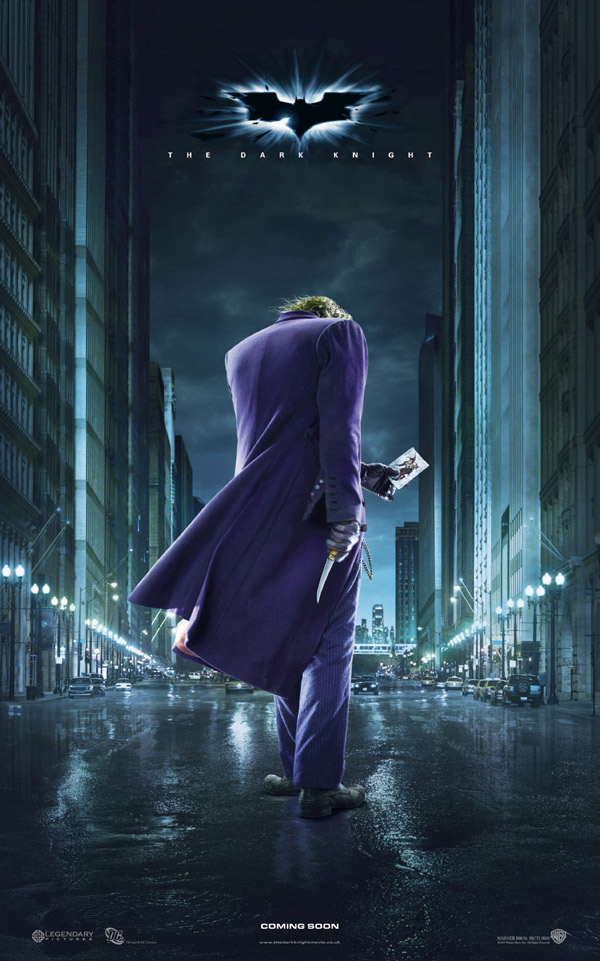
The Dark Knight - Masterpiece or Hype?


So what did everybody think of The Dark Knight? Let's hand this one over to you. Instead of a stuffy review why not give us your thoughts instead? Post a comment here and join the debate.

Tuesday, July 22, 2008

The Wackness


We've spoken at great length on this site about the potential pratfalls involved in making a typical indie movie and there's none so typical as the low-budget coming of age movie with a quirky indie spirit. Sometimes it works to the point where the movie overcomes the inevitability of the teenagers in question being painfully irritating (see Juno for reference). Other times it doesn't.

The Wackness hits screens fresh from success at Sundance (of course) and sounds like a cross between Charlie Bartlett and Thumbsucker in its tale of a loner high-school graduate who takes to selling pot for a day-job whilst attending therapy with a stoner shrink who is his best customer and could be his best friend.

Where The Wackness succeeds in differentiating itself is in its unusual stylistic choices. It's set in the early 90's for almost no discernible reason (the protagonist is a white-boy who listens to hip-hop instead of grunge, which may set him apart in the 90's but surely a similar distinction could have been made today). The colour grade is extreme and stylised with sickly greens and sepia browns making it look almost like a low-budget thriller or prison drama rather than the light hearted dramedy that it is. It could be jarring but what it does is takes us away from expectation and formula and anything that makes us feel like we've seen this sort of thing before.

The two central performances are of the highest order. Ben Kingsley will get all the plaudits for his entertainingly unhinged, eccentric shrink but whilst his performance is undeniably enjoyable and scenery-chewing, it still falls into the category of predictably quirky. The real kudos should go to Josh Peck who impressed so much a few years ago in Mean Creek and who now offers us a subtle, bravely nuanced performance which has the courage to remain stilted and isn't preening for attention or showing off. The kid is somewhat numb to the world, insulating himself at all times and accordingly that's exactly how Peck plays him.

Unfortunately, the movie is meandering and quite directionless in its story-telling. There seems to be little indication of what anybody wants to do or achieve until right near the end. Consequently, it flags in places and whilst it isn't attempting to be a comedy, it still isn't as funny as it thinks it is. It does finally come together to pack an emotional punch and just about manages to amount to the sum of its modest parts and it deserves extra credit for treating familiar material with a fresh eye. Now that Josh Peck has lost the weight of his younger years, which could have pigeon-holed him, Hollywood should come knocking...if there's any justice (Editors note: there isn't).
3/5

Friday, July 18, 2008

The Mist

The Mist is Frank Darabont first directorial effort since The Majestic. After the success of his earlier films The Shawshank Redemption and The Green Mile, the Majestic was a failure critically and commercially. The Mist, a horror with a seventies b-movie style, his third adaptation of Steven King material sees Darabont return to form.

As the film begins we are introduced to artist Dave Drayton (Thomas Jane) and his family. As night falls a storm hits their little town in Maine. The following morning as an ominous Mist closes in on the town Drayton, his son and his neighbour head into town to get supplies. By saying more we would run the risk of giving away to much. Which would be a really pity, this is a film where the less you know going in the better.

Suffice to say that The Mist is well worth the trip to the cinema. Strangely for a horror it is observing how the characters react to the pressure they are put under rather than the action itself that makes this film so great. The ensemble cast is excellent here with some great performances. Particularly from Marcia Gay Harden and Toby Jones. Even Thomas Jane, though an actor of limited ability, gives a solid performance in the lead role.

The action though is also great, with some excellent CGI. Despite its 126 minute running time, it doesn’t seem like a long film as Darabont keeps us enthralled throughout. Go enjoy!

4/5

Thursday, July 3, 2008

The Visitor


It has long been acknowledged that there is barely such a thing as a real indie movie anymore. Most so-called indie movies are actually financed by specialist arms of major studios or by companies that are ultimately owned by the same corporations as the major studios. If a movie is made independently, it is almost always picked up for distribution by a major. So it seems the term indie is used more as a reference to style/genre/ethos than to a specific financial category. As with any style/genre (we use the term loosely here since it probably doesn't strictly fit the bill) there are formulas and audience expectations that make them feel predictable. This is particularly true of the character-based 'life-affirming' indie as opposed to the low-budget guns and gangsters kind. There's definitely a creeping sense among audiences that we've seen it all before.

It's into this difficult climate that Tom McCarthy's sophomore film The Visitor emerges. McCarthy's is an actor turned director whose debut film The Station Agent was a small, charming gem that deservedly garnered critical acclaim on the festival circuit and arguably added to the template of 'typical indie fare'.

The Visitor is about a lonely college professor who has effectively resigned from life until he finds 2 immigrants squatting in his apartment. The trio become unlikely friends and life lessons are learned, passion for life is re-ignited, residual grief over dead relatives is surmounted, romance is hinted at, but never overtly expedited (nothing so crass!) and credits role amid much ambiguity.

All this is fine and works extremely well in many indie films, in much the same way as a thriller can be formulaic but gripping if it's treated right. As mentioned The Station Agent is so full of easy-going charm that it succeeds brilliantly within this formula. The Visitor however, is a more difficult beast, to be admired for certain reasons and to be given the cold shoulder for others.

What makes this admirable and unusual for a character-based indie movie is its political edge and it's acute sense of anger at the treatment of asylum seekers. It manages to tackle an issue, if not quite head on, then through the indirect prism of the characters' worlds and is all the better for this angle of exploration. It doesn't feel preachy. It doesn't seek to inform but rather to explore and help find understanding.

That said, this causes some associated problems. The film can never quite decide if this is a story about a man rekindling his zest for life or whether it's a story about a man finding his passion through anger and a sense of righteous indignation. It seems the latter scenario would be fresh and interesting for a film of this type (or for any film for that matter - as Jonny Rotten said; anger is an energy - one too often ignored). Instead, what happens is that the zest-for-life moments sit a little incongruously in such a sombre, morose piece with the result that they feel shoehorned in and stick out as what they are, boring staples of the 'genre'.

It seems a strange criticism to level at a movie but this wasn't as enjoyable and entertaining as The Station Agent quite simply because it lacked that movie's charm. Yet it fails to break new ground and be an unusual example of the form, in that it tries too hard to have charm. Damned if you do. Damned if you don't. It's still a damned good effort and worth a look.

3/5

Sunday, June 15, 2008

The Incredible Hulk


Early expectation of this rebooted version of the Marvel’s ‘Hulk’ franchise was not great since some considered ‘The Incredible Hulk’ to be one of the risky releases of the summer. Since audiences were under whelmed by Ang Lee’s decent 2003 ‘Hulk’ film and in the months leading up to the release of this incarnation (co-written by Edward Norton and Zack Penn, and directed by ‘The Transporter’ helmer Louis Leterrier) the internet was rumbling of editing room arguments between Norton and the producers over the theatrical cut of the film; all this combined with a late marketing campaign boded ominously for the film’s release.

If anything ‘The Incredible Hulk’ knowingly owes buckets to the successful 70’s TV series. If you had seen that as a child you too would remember diving behind the couch as David Banner transformed into the Hulk. And it’s because of this connection that there is a warm comfortable familiarity surrounding ‘The Incredible Hulk’. Edward Norton’s ‘Bruce Banner’ reminds us of ‘David Banner’ of the series, wandering the world trying to find a cure for his green condition while encountering troublesome locals who just insist on making him angry.

But this is also a hindrance to the film. ‘The Incredible Hulk’ never feels like more that an extended television episode where the themes and the texture are thin. Edward Norton’s Bruce Banner is somewhat underwhelming and almost vacant. He’s neither as entertaining as Tony Stark or as complex as Bruce Wayne, he’s just a bit, well, boring. Which is a shame since we all know how fine an actor Mr. Norton is and the character of Bruce Banner should be fertile ground for a cerebral exploration into the root of Banner’s rage; maybe a study on repressed paternal rage… Wait, they did that and fans hated it, oh well, no character development then.

This leads us to the reputed missing seventy minutes. Certainly ten or fifteen of those are covered in the opening montage but one has to wonder what was lurking in the cut pieces of celluloid. Where the producers so scared by the underperformance of the 2003 film that they removed any material that wasn’t pertinent to fulfilling a ‘HULK SMASH’ film? Maybe a DVD cut will answer the fans speculation.

‘The Incredible Hulk’ works in its visceral set pieces when the Hulk finally gets to unleashes his fury; notably in an exhilarating sequence on a college campus where the Hulk faces off against the military. And it’s the direction of these action scenes where director Leterrier should be applauded, his experience of OTT comic book action from ‘The Transporter’ films certainly pays off here. Also, Tim Roth’s ‘Super Soldier’ antics are a pleasant surprise by miraculously not looking crap.

The film’s major down fall are it’s characters, from Liv Tyler’s shrinking ‘Betty Ross’ to William Hurt’s over distant and snarling ‘Gen. Ross’, all are literal adaptations from the comic book pages. Something which is not necessarily a good thing since film audiences are more accustomed to some sort of character development.

Of course, we are now in uncharted cinematic territory with this coming stable of ‘Marvel’ films. For the first time in Hollywood cinema, Marvel will be expanding the universe of there characters across several different franchises and ultimately unifying in a team up film of ‘The Avengers’ to be released in 2011. This ambitious and expensive endeavour in turn limits the range of movement of the individual films since they must consider a unity of tone and character for not only their own franchise but the super-franchise of ‘The Avengers’.

At the end of the day, ‘The Incredible Hulk’ looks and feels like an updated version of the classic 70’s TV show, a little bit episodic and underdeveloped but when the Hulk does rip through Bruce Banner quaint garments it’s a real treat.

3/5

Sunday, June 8, 2008

Gone Baby Gone


After a four year old girl is kidnapped and a flailing police investigation the child’s aunt hires two private detectives (Casey Affleck and Michelle Monaghan) to look in the seedy crevasses the cops cannot.

For audiences who have seen the Clint Eastwood directed ‘Mystic River’ they will find themselves in familiar territory with ‘Gone Baby Gone’ since both films are adapted from Dennis Lehane novels. It’s not only the sourced author that both films share, there is a sense that director and co-screenwriter Ben Affleck was keeping a close eye on Eastwood’s film when creating this project. And in doing so, he has managed to imitate both the accomplishments and shortcomings of ‘Mystic River’

It’s in the adapting that ‘Gone Baby Gone’ begins to fall short of the mark of an altogether satisfying crime story. The second half of the film feels like an abridged version of the novel where voice over and flashbacks do most of the story telling. Despite this being a detective film where both those devices are staples in the genre, here, they feel like short cuts and take away from an engaging first half.

Despite this Affleck’s directorial debut is a solid success. He brings to what could have been a conventional Hollywood thriller a personal touch, making the landscape of the film real and harnessing solid performances from the cast, notably from brother Casey Affleck. It’s in the films final moments where it regains itself and left this reviewer feeling that writer and director Affleck could become a solid Hollywood director.

Who would have thought ten years ago that younger brother Casey will have the greatest potential to be the leading man over the Affleck brothers. But Casey is a hero for the 21st century, the disenchanted century where our heros are the trusted boys next door.

‘Gone Baby Gone’ is a solid entertaining detective film which are too far and few these days. It’s almost a four star film, almost. The trip up in the second half makes it fall just short of the mark but it will be enjoyed by anyone looking for a good old crime yarn.

3.75/5

Monday, May 26, 2008

Indiana Jones & The Kingdom Of The Crystal Skull


Gee whizz! How does one review this movie? Perhaps it would be easier to transport oneself back to childhood to remember the excitement that an Indy film would arouse. If that seems difficult, ask George Lucas how he has manged it. He appears to have remained a child trapped inside the body of an aging Alf the alien lookalike. It seems anything he touches these days is tinged with the feverish and unfocused excitement of a kid with a big train set.

Until we talk to George, you'll have to put up with an adult review for the moment. Crystal Skull has a set-up that, like it or hate it, comes right out of the Spielberg and Lucas playbook. Indy becomes embroiled in the a quest for a Crystal Skull that the Russians (the new baddies) are seeking as it may have powers that are not of this earth i.e. extra-terrestrial. So it's heroes, action and aliens and a bit of sci-fi. The key to this quest is finding an loopy professor and the mother of Shia LeBeouf's cheap imitation of a young Brando. Yes, we are now in an era that Lucas and Spielberg can personally remember, the 1950's. Thus the reds are under the bed, the UFO's are in the sky, everybody looks like an extra from Grease and soft focus apple-pie Americana is everywhere.

Lucas and Spielberg lay all this on thick but somehow the 1st act still works quite well. It zips along at a nice pace and with good humour, charm and top-notch action set-pieces that never let Indy veer into CGI superhero territory. We feel his human limitations and believe the peril we're seeing even if the Russians obviously went to baddie shooting school. Then the quest and the goal arrive and he sets off upon Act 2 and things start to creak until they fall apart.

A horribly expedited plot leads to a quest we don't quite understand involving characters we don't really care about for reasons we're unsure of and we begin to wonder why everybody doesn't just pack it up and go home. That said, putting on rose tinted kid glasses, wasn't this the case with the previous 3 and they worked quite well. The plot is of course irrelevant so as long as all the other ingredients work then what's the problem?

Well ingredient 1 is the breakneck, popcorn friendly old-school action sequences that had us all having epi-fits as kids. Well the bad news is these just don't work. Though impressively choreographed and executed as one would expect of Spielberg, they betray the spirit on an Indy movie in that a) Indy and many of the other principles feel superhuman and immune to injury of any sort. b) Simplicity is jettisoned for an orgy of over-the top action with CGI that feels like it's straight out of The Mummy. There are (almost) no booby traps, closing walls, bridge's over corcodile pits and trap doors from which to rescue his hat. Instead we have characters impossibly swinging from tree to tree on vines as if they are Spiderman, surviving waterfall drops as if they were immortal and straddling 2 jeeps simultaneously as if they were...well, as if they were on a green screen stage in front of a wind machine quite frankly. In other words, simple effective visual drama is exchanged for meaningless, supposedly awesome spectacle. The curse of the CGI era. Shock and awe over story.

Ingredient 2 is Indy's dry wit. Apart from the first act it's mostly missing. Harrison Ford just doesn't have the timing any more and his one-liners are hopelessly cheesy. When he winds up for one, we see Harrison not Indy and we cringe appropriately. To be fair, he's not the only one to let the side down. It's perhaps harsh to say but there might be a reason that Karen Allen hasn't had much work since Raiders. 2 words. Ham Sandwich.

Ingredient 3 is Indy's repeated character arc of reluctant sceptical hero who ends up doing things for the right reasons and truly believes in the mystical power at the end. This is hiding among the mess somewhere, but it's unfocused and unclear and ultimately unsatisfying.

Ingredient 4 is our respect and love of Indy for just being so damn kick-ass and all-knowing. Here he makes so many mistakes that the audience are just screaming at him to cop on! Keep an eye out for his relationship with Ray Winstone's shamefully underwritten character as an example.

To be fair, this isn't a disaster. The set-up is good and it offers us a chance to view Indy in a new era and in an altered cultural landscape, which justifies his return. Dispite the criticisms above, this is still an Indy movie and there are enough traces of the original ingredients of the recipe to make this taste like the real thing. It's fun, it's unpretentious, it's technically well-crafted, and it seems to have been done in the right spirit. Whereas John McClane's return pissed all over the legacy of a rounded trilogy and offered no artistic reason for the comeback, this just about manages to fall closer to Rocky than Rambo in this emerging aging hero sub-genre.

Lucas and Spielberg neither deserve a pat on the back nor a bat to the head. I can't help wonder how Lucas would defend our criticisms if he had the chance. Based on this slice of Americana apple-pie, one suspects he might stay stuff like gee whizz!

2/5